
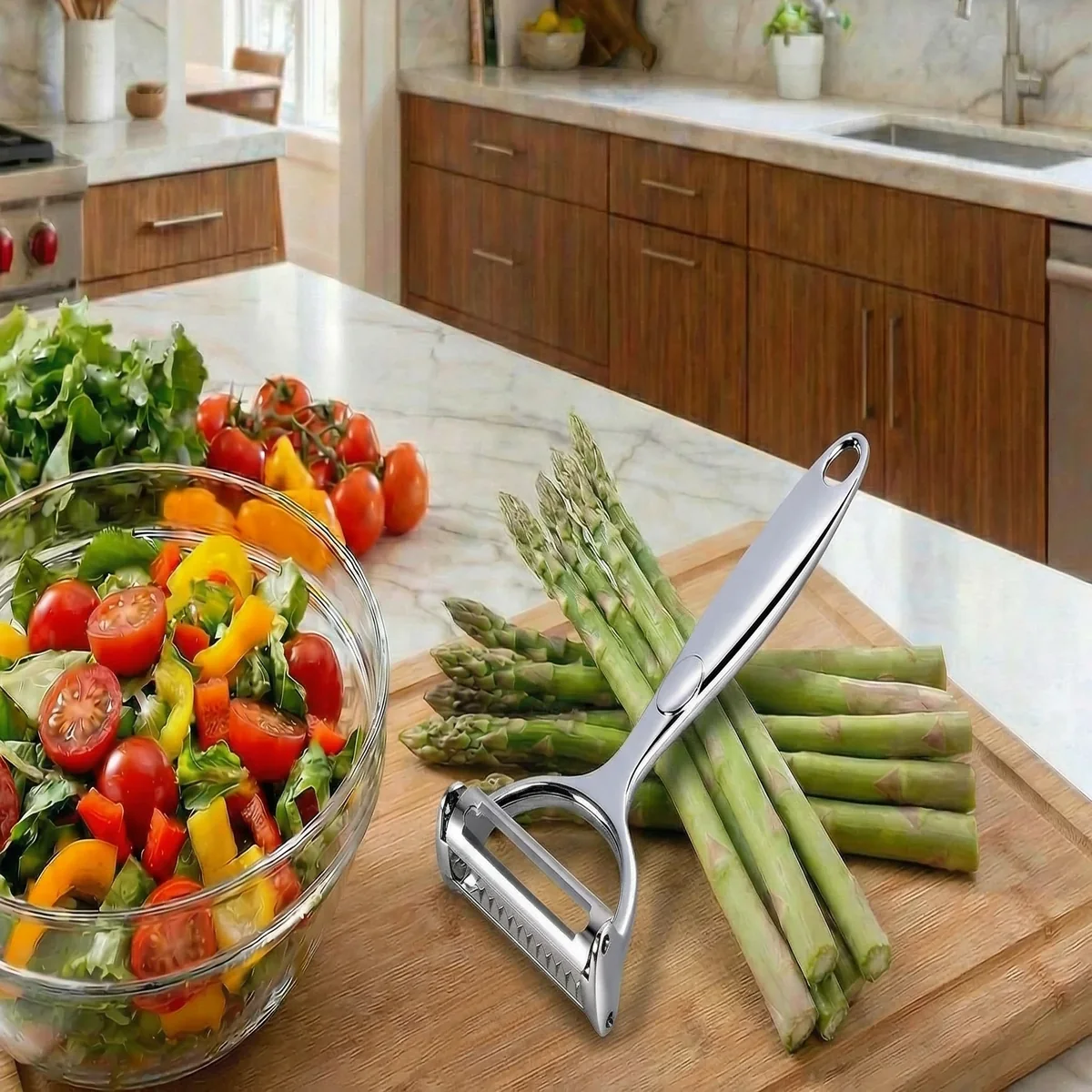
The short answer: choose a vegetable peeler in three separate steps. First, pick the handle layout you can control: an I-shape for a straighter, pencil-like grip or a Y-shape for a wider, palm-led grip. Second, pick the cutting function: a smooth edge for removing peel or a julienne edge for making narrow strips. Third, check the care instructions for the exact handle and blade you are buying. No single peeler is the automatic winner for every hand, ingredient, or kitchen routine.
That distinction matters because product descriptions often blur together three different choices: the shape of the handle, the job done by the blade, and the material that changes how the tool should be cleaned. Treating them separately makes it easier to buy a tool that fits the work you actually do.
What matters first
Start with control, not a feature count. A useful peeler should let you keep the ingredient stable, see where the cutting edge is going, and move without forcing your wrist into an awkward angle. The same person may prefer an I-shape for a long carrot and a Y-shape for a round potato. That is a normal difference in motion, not evidence that one design is universally better.
| Buying question | What to look for | Why it matters |
|---|---|---|
| How do you naturally hold a small tool? | I-shape for an in-line grip; Y-shape for a crosswise grip | The handle layout changes hand position and stroke direction |
| What result do you need? | Smooth edge for peeling; toothed julienne edge for narrow strips | Blade function is separate from handle shape |
| What do you prepare most? | Consider produce shape, firmness, and the length of each stroke | A steady path is more useful than a broad promise |
| How will you care for it? | Read the instructions for the exact material and model | Wood handles and all-metal tools do not always share the same care routine |
1. Choose the handle layout you can guide steadily
An I-shape peeler places the handle and cutting head in one line. People who guide small tools with their fingertips may find that orientation familiar. It can provide a clear path along long, firm produce such as carrots or cucumbers. Rotate the ingredient between strokes instead of bending your wrist around a curve.
A Y-shape peeler places the cutting edge across the top of the handle. Your palm and fingers sit behind a wider frame, which can feel direct when you make shorter passes over potatoes, apples, or other rounded produce. Keep your fingertips clear of both ends of the blade and turn the food as the surface changes.
These are practical starting points, not strict rules. Either layout may work on many of the same fruits and vegetables when the ingredient is stable and the user can keep the cutting path clear. If you want a closer look at hand position and stroke direction, read the I-shape and Y-shape vegetable peeler comparison.
2. Choose the blade for the result you want
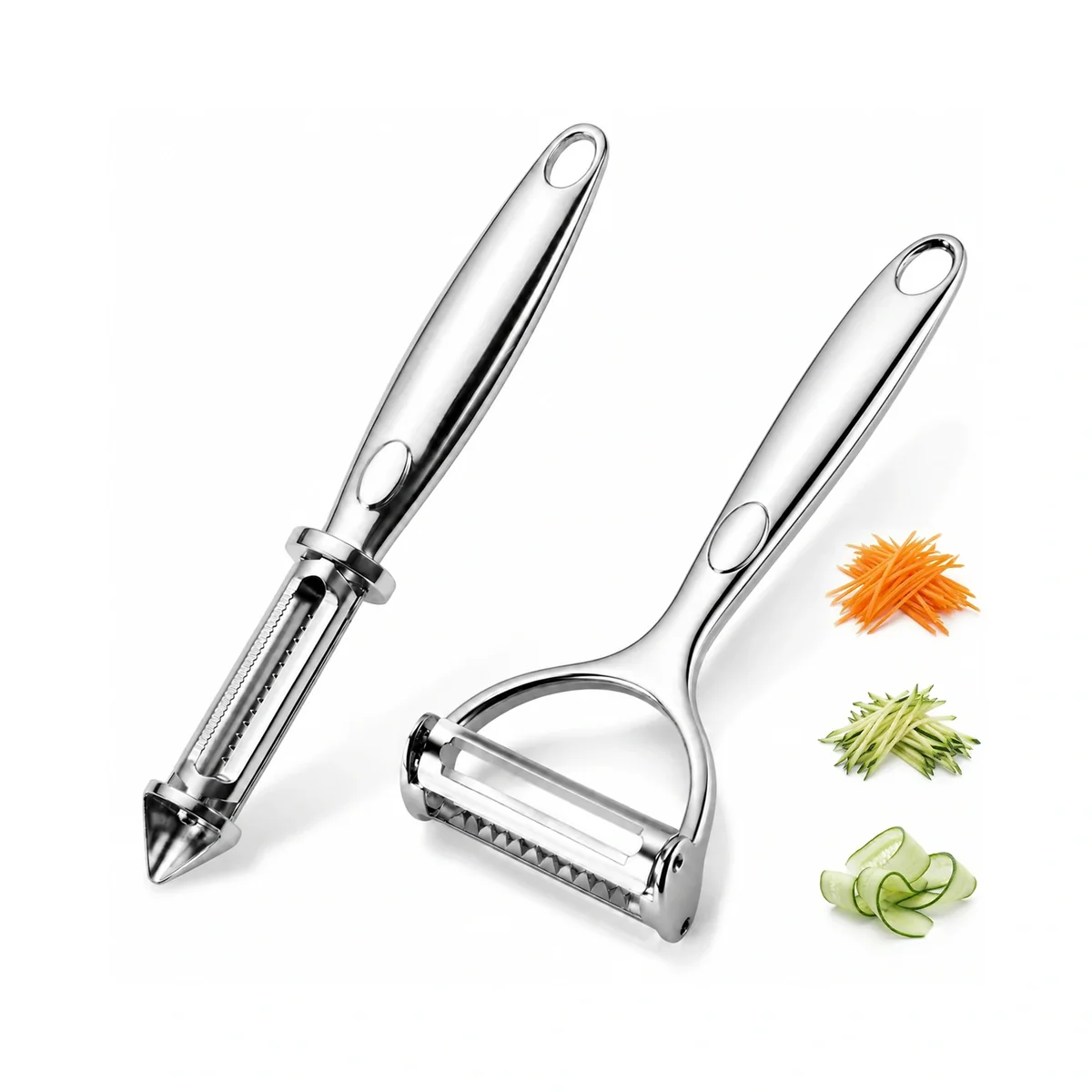
A smooth peeling edge and a julienne edge solve different problems. A smooth edge removes the outside layer from suitable produce. A toothed julienne edge cuts narrow strips that can be used in salads, bowls, garnishes, or quick-cooking dishes. The teeth do not turn the tool into a general slicer, and soft or overripe food may not hold its shape well enough for clean strips.
Do not assume that every I-shape peeler has one blade type or every Y-shape peeler has another. Handle layout describes how you hold the tool. Blade design describes what the cutting edge does. Some ANGEER stainless-steel options place smooth and julienne functions on the same peeling head, while other models are intended for ordinary peeling.
If you regularly switch between removing peel and making vegetable strips, compare the blade views on the dual-blade julienne peeler page. Look at which edge will face the food, how you will keep the unused edge away from your fingers, and whether the ingredient gives you a firm, clear path.

3. Match the peeler to the food and the task
Produce shape is useful, but it is not the only condition. Firmness, surface texture, size, and how securely you can hold the ingredient all affect the motion. Before peeling, the US Food and Drug Administration advises washing produce under running water, including produce that will be peeled. Drying a slippery ingredient can also make it easier to hold steadily.
| Common task | A practical starting point | Check before you begin |
|---|---|---|
| Long carrots or cucumbers | I-shape for a lengthwise path, or Y-shape for shorter passes | Use firm produce and rotate it between strokes |
| Potatoes or apples | Y-shape for a palm-led pass, or I-shape if that grip is steadier | Follow the curve without twisting your wrist |
| Ordinary peeling | Smooth edge | Keep the layer thin and the blade path visible |
| Narrow vegetable strips | Toothed julienne edge | Use firm produce and stop before your holding hand reaches the cutting path |
For small ingredients, place the food on a stable board when holding it in the air would bring your fingers too close to the blade. Stop before the remaining piece becomes difficult to control. A peeler is not the right tool for every final scrap, and forcing the last stroke is not worth losing a stable grip.
4. Let handle material guide the care routine
Material affects feel, weight, and care, but it does not prove that one peeler will suit every cook. An all-stainless-steel tool keeps the handle and head in the same material family. Follow the care instructions for the exact model instead of extending one material description into extra claims about cleaning, corrosion, or drying.
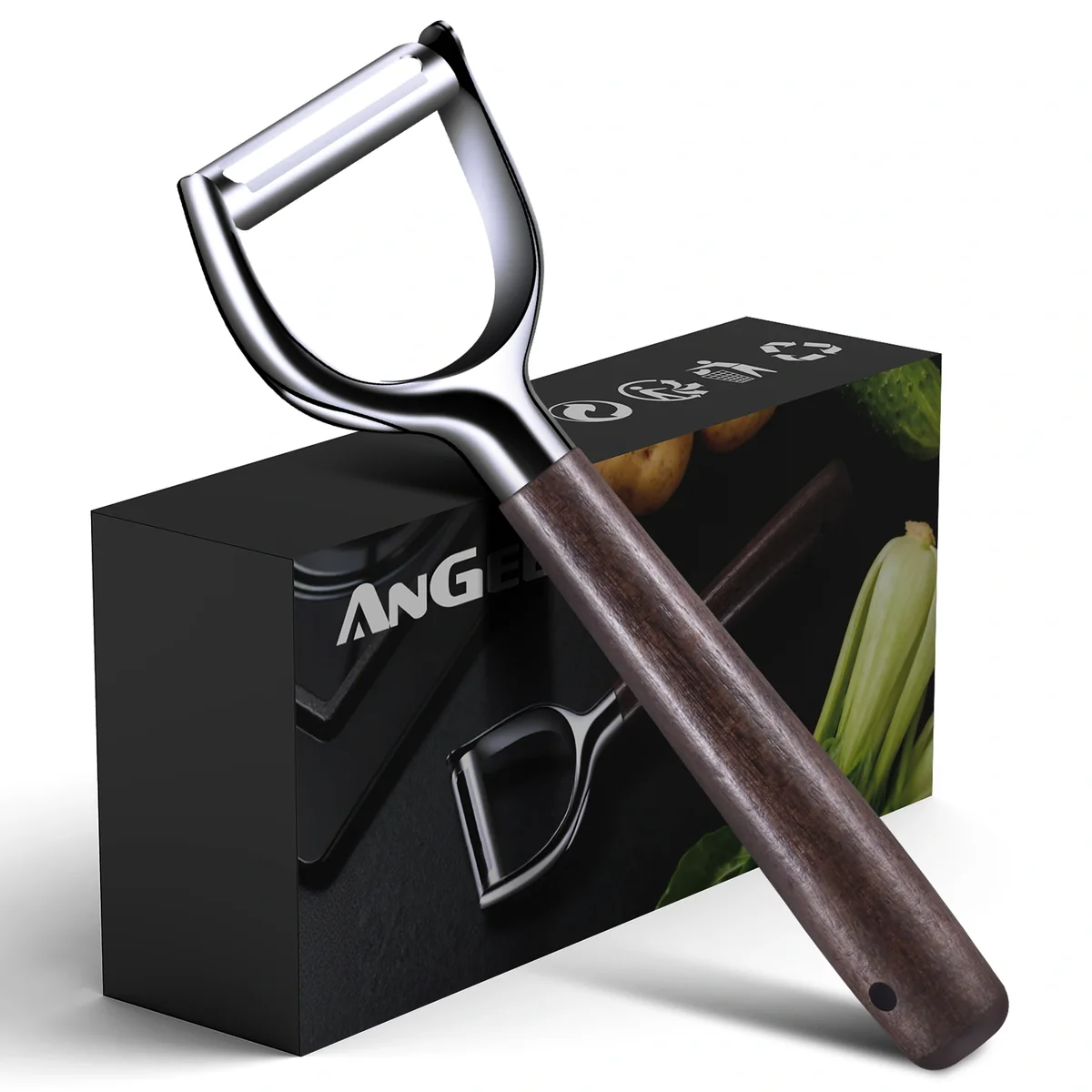
Natural wood handles bring a warmer surface to the grip and require a more specific routine. For the ANGEER wood-handle peelers covered here, hand wash the tool, dry it promptly, and do not leave it soaking. The exact wood species is not stated in the verified product evidence, so the useful buying fact is the care requirement rather than an unverified material label.
Compare the available I, Y, and I + Y options on the stainless-steel 2-in-1 peeler page and the wood-handle vegetable peeler page. Check the selected variant, the pieces included, the blade views, and the care information before you buy.
5. Use a buying checklist instead of looking for a universal winner
- Name your two most common ingredients. A routine built around long carrots may point you toward a different grip than one built around potatoes.
- Choose the hand position. Decide whether an in-line I-shape or crosswise Y-shape gives you a clearer, steadier path.
- Choose the cutting result. Buy a smooth edge for peeling, a julienne edge for strips, or a verified dual-function model if you need both.
- Check the selected variant. Confirm whether you are buying one I-shape tool, one Y-shape tool, or an I + Y set. Do not rely on a collection image alone.
- Read the care line. Follow the exact instructions instead of making extra assumptions from appearance or material wording.
- Plan safe storage. The blade should not catch a hand reaching into a crowded drawer. Use a divider, protected position, or other storage method that keeps the cutting edge out of the normal reach path.
Common buying mistakes to avoid
The first mistake is treating I-shape, Y-shape, smooth, and julienne as four competing versions of the same feature. They describe two different decisions: grip and blade. The second mistake is choosing from a lifestyle image without confirming the exact variant. A set photo may show two tools even when the selected option includes only one.
The third mistake is relying on broad claims about ease, corrosion, certification, or lifespan when no supporting evidence is shown. Those phrases do not answer the questions that matter at the counter: Can you hold the tool steadily? Does the edge make the result you want? Are the included pieces clear? Can you follow the stated care routine?
Finally, do not buy a julienne edge simply because it adds a second function. If you only peel potatoes and apples, a well-matched smooth edge may be the more useful choice. If salads and vegetable strips are part of your normal week, the second edge may earn its place. The value comes from a real task, not from the number of features in a title.
A practical decision in under a minute
If you mostly peel long, firm produce and naturally guide tools with your fingertips, begin with an I-shape and a smooth edge. If you mostly peel rounded produce and prefer a wider palm-led motion, begin with a Y-shape and a smooth edge. If you want narrow strips as well as ordinary peeling, look for a verified julienne edge in the handle layout you can control. If your ingredients and hand positions vary, an I + Y set can provide both layouts without pretending that one grip fits every task.
That is enough to narrow the choice honestly. Confirm the exact variant and care instructions, then choose the tool whose grip, blade, and maintenance all match your real kitchen routine.
Source
- US Food and Drug Administration, 7 Tips for Cleaning Fruits, Vegetables. Used only for the produce-washing guidance above. Accessed August 27, 2026.
Practical answers
Vegetable peeler buying FAQ
What type of vegetable peeler should I buy?
Choose the handle and blade separately. Start with an I-shape if you prefer a straighter, pencil-like grip, or a Y-shape if you prefer a wider, palm-led grip. Then choose a smooth edge for peeling or a toothed julienne edge for narrow strips.
What is the difference between a smooth peeler and a julienne peeler?
A smooth peeling edge removes the outside layer from suitable produce. A toothed julienne edge cuts narrow strips. The blade function is separate from whether the handle is I-shaped or Y-shaped.
Can one vegetable peeler handle both peeling and julienne cuts?
Some verified ANGEER stainless-steel options place a smooth edge and a toothed julienne edge on the same peeling head. Check the selected model and blade views before buying because not every peeler combines both functions.
Is an I-shape or Y-shape peeler better for potatoes?
Neither shape is universally better. A Y-shape can suit a palm-led pass over a rounded potato, while an I-shape can work when its in-line grip feels steadier. Choose the layout that keeps the potato stable and the blade path clear.
How should I clean a wood-handle vegetable peeler?
For the ANGEER wood-handle peelers covered here, hand wash the tool, dry it promptly, and do not leave it soaking. Follow the care instructions for the exact selected model.
What should I check before buying a vegetable peeler set?
Confirm the exact variant, included pieces, blade functions and care instructions. A collection image may show an I-shape and a Y-shape together even when the selected option includes only one tool.