
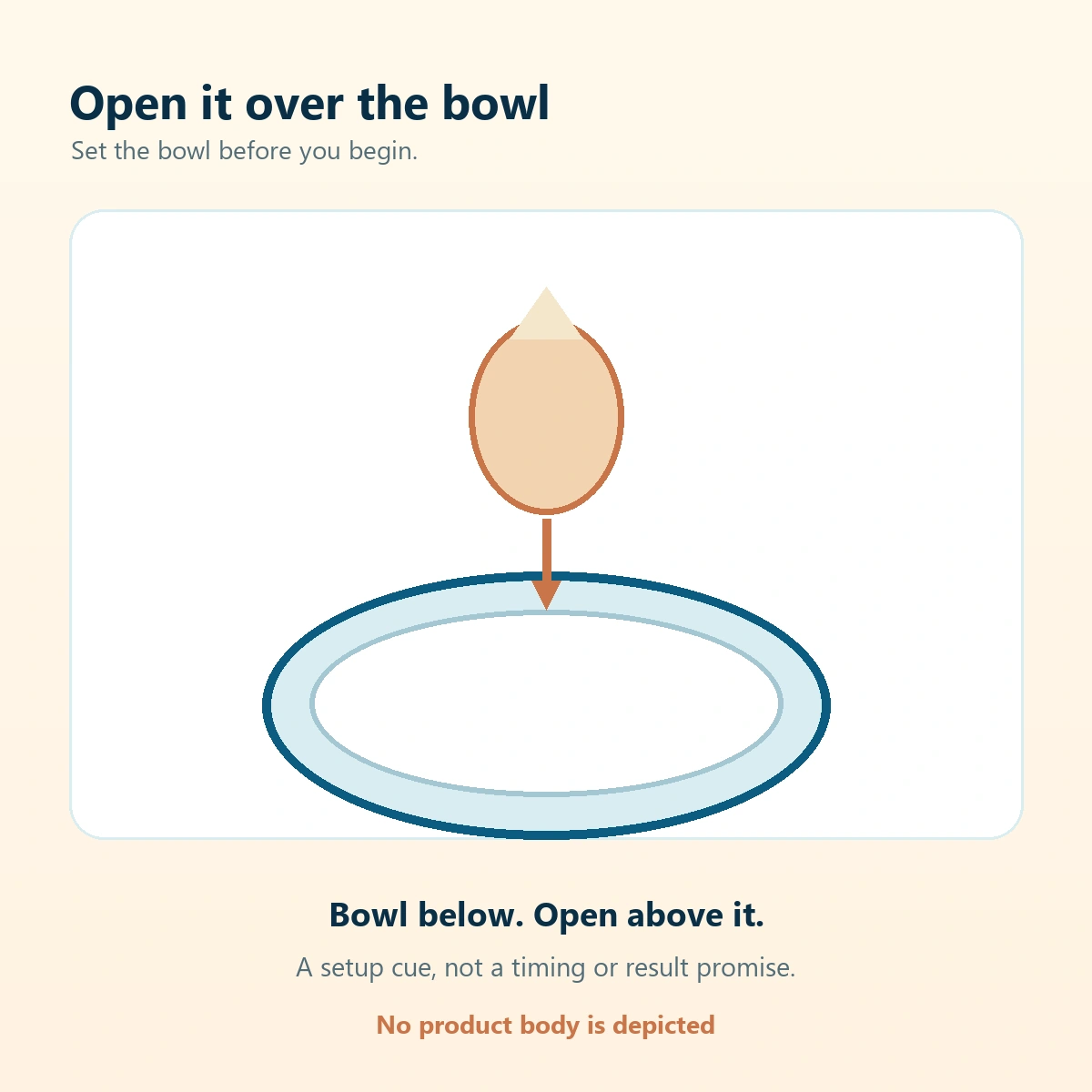
The short answer: open the tool, seat a raw egg in the cradle, close the two halves, and use a controlled close-and-open motion directly over a bowl. Keep your fingers away from the internal metal opening edges, and inspect the bowl before the egg goes into your recipe because egg size, shell thickness, and technique can change the result.
An egg cracker tool is small, but the setup decides whether the motion feels manageable. The bowl needs to be ready before the egg goes into the cradle. Your hands need a clear place to hold the outer body. The egg should sit inside without being forced. Those details matter more than trying to copy the speed of a short product clip.
Set up the bowl before you pick up the egg
Start with a bowl that is large enough for the egg and stable on the work surface. Put it where both hands can reach the tool without crossing over the rim. The bowl is not an optional background prop. It is the destination for the raw egg as soon as the shell opens.
Open the cracker before you lift the egg. Look at the cradle and identify the internal metal opening edges. Your grip belongs on the outer body, not in the cutting area. If you are still deciding which color or pack fits your kitchen, the ANGEER Silicone Egg Cracker product page shows the current choices. The handling method is the same across the verified red, green, yellow, and mixed-pack range.
This tool is for a raw egg. If you are trying to remove the shell from an egg that has already been cooked and cooled, stop here. The raw egg cracker versus boiled egg peeler guide explains why those two tools have different inputs and motions.
Use the egg cracker in five controlled steps
- Place the bowl first. Center it below the working area so the raw egg has a direct path into the bowl when the tool opens.
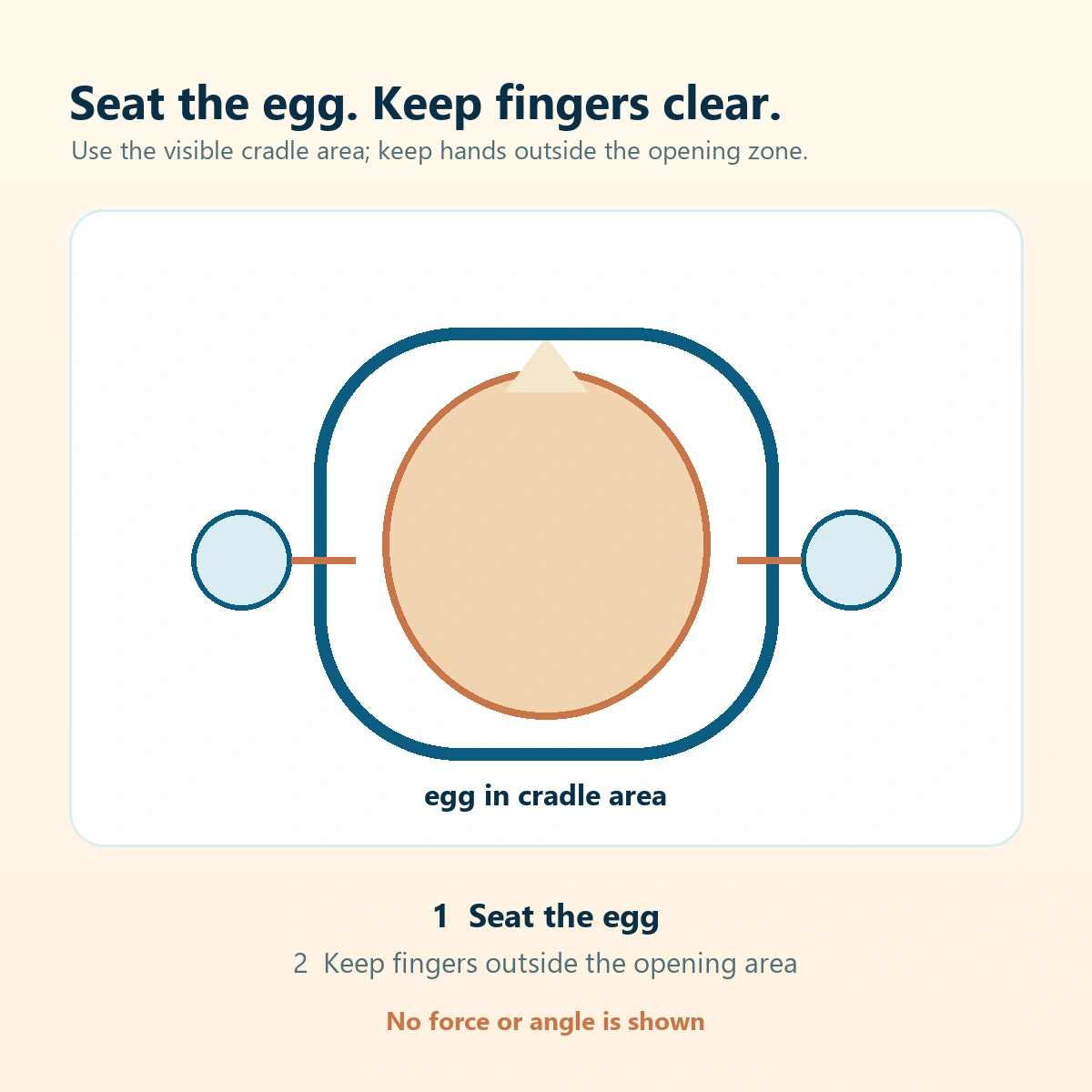
- Open the tool and seat the egg. Put the raw egg in the cradle. It should rest inside without being forced against the body.
- Keep fingers outside the metal edges. Hold the outer halves. Do not put a fingertip between the egg and an opening edge.
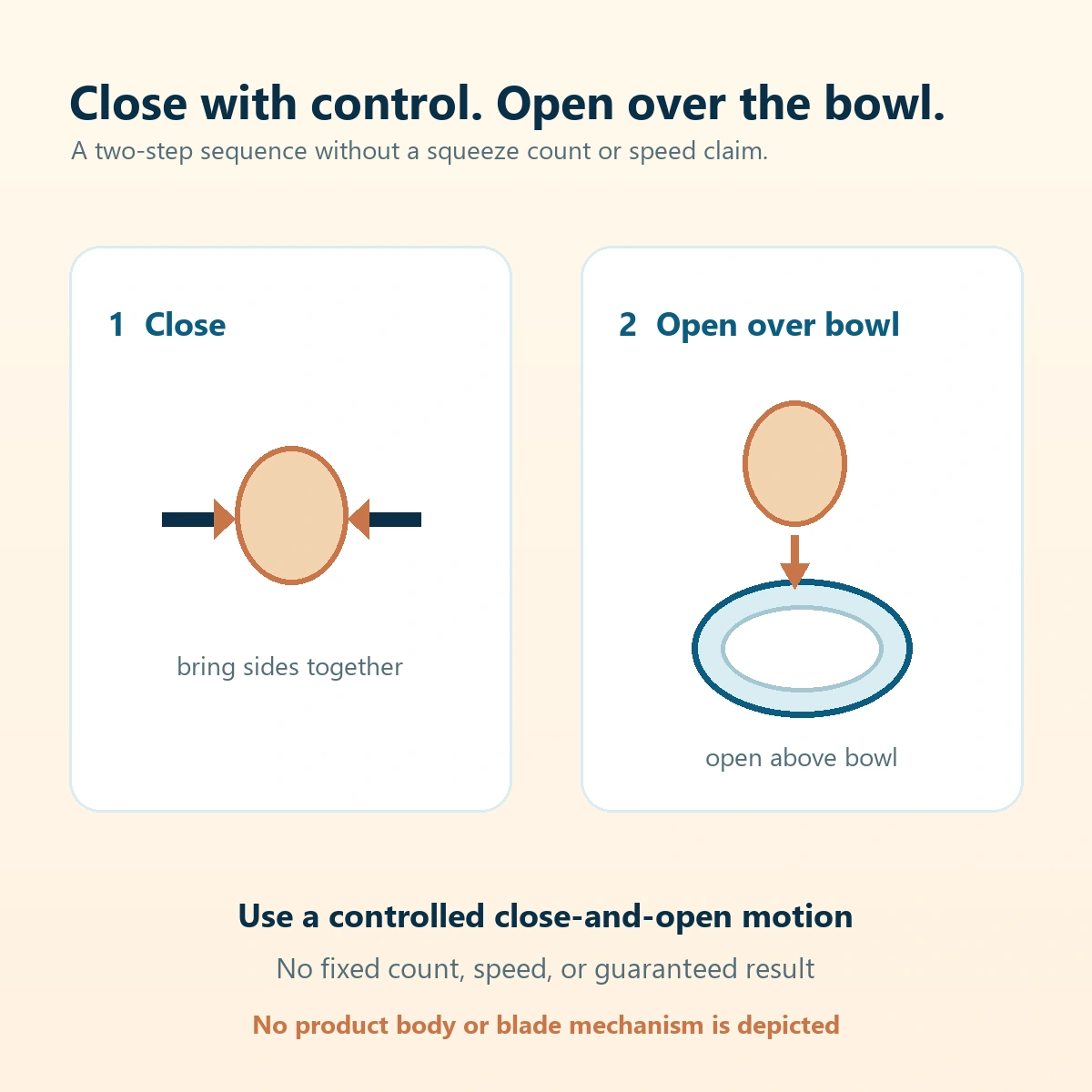
- Close with control. Bring the two halves together around the egg. The evidence supports a controlled motion, not a hard squeeze, a fixed force, or a race against a timer.
- Open directly over the bowl. Separate the halves so the raw egg drops into the bowl. Then look at the bowl and remove any visible shell before continuing with the recipe.
The final inspection is ordinary kitchen judgment, not an admission that the tool failed. Shells vary. A product page cannot honestly promise that every egg will open in the same way or that no fragment can ever appear. The useful standard is simpler: use the documented motion, keep the work over the bowl, and check the result you actually have.
What a controlled close-and-open motion means
Controlled does not mean slow for the sake of being slow. It means that you can stop if the egg shifts, the tool feels misaligned, or your fingers move toward the metal edges. Close the halves deliberately. Keep the bowl beneath the tool. Open only when the tool is still over the bowl.
Supplier text sometimes turns a short motion into a fixed-time promise. That is not a useful instruction. There is no verified number of seconds that applies to every egg, and there is no evidence-backed reason to squeeze as fast as possible. A video can show where the hands and bowl belong, but it cannot guarantee the same result for a different egg in a different kitchen.
| Handling question | Evidence-backed approach | Do not assume |
|---|---|---|
| Where does the tool go? | Directly over a stable bowl | That the contents will land in a distant pan or container |
| How should the egg fit? | Seated in the cradle without forcing it | That every egg size fits the same way |
| How should you close it? | With a controlled motion you can stop | A fixed force, speed, or number of seconds |
| What happens after opening? | Inspect the bowl before continuing | A universal shell-fragment-free result |
Why egg size and shell thickness can change the result
Eggs are not identical parts. The verified instructions specifically warn that egg size and shell thickness can affect the result. That is why the procedure starts with fit rather than force. If an egg does not sit in the cradle, pressing harder is not the next step.
Remove an oversized egg and open it another way, or choose one that rests in the cradle without being forced. If the shell does not open as expected, stop and reset rather than adding an arbitrary squeeze count. Keep the egg over the bowl while you decide what to do next.
A shell piece in the bowl does not support a sweeping claim about the product, positive or negative. It shows why the inspection step belongs in the method. Remove any visible shell before the egg enters the rest of the recipe. The same check makes sense whether you are preparing a single breakfast egg or several eggs for batter.

Treat the internal metal edges as the cutting area
The silicone outer body does not turn the whole object into a soft toy. The opening edges inside are metal. Hold the outside of the tool and keep fingertips away from the path where the two halves meet the shell.
That boundary matters when a child is nearby. The verified product guidance does not call the tool child-safe. It identifies the product as a kitchen tool and requires close adult supervision for any child participation. An adult should control the setup, keep fingers clear, and decide whether the situation is appropriate.
Do not use a cheerful color or egg-shaped shell as evidence about safety. Color and shape describe the product’s appearance. They do not replace attention to the internal metal parts.
Troubleshooting without forcing the tool
The egg will not sit in the cradle
Take the egg out. Do not push an oversized egg farther into the tool. Use another opening method or choose an egg that sits without being forced.
The shell did not open as expected
Keep the egg over the bowl, stop the motion, and check the fit. Do not invent a harder squeeze or a fixed number of repeat presses. If the tool and egg no longer feel aligned, remove the egg and finish with another appropriate method.
A shell piece is visible in the bowl
Remove the visible piece before you continue cooking. The evidence does not support a guarantee that every use will be free of shell fragments.
The egg missed the center of the bowl
Reset the bowl before the next egg. Bring the tool directly above the center and keep it there through the opening motion. Reaching sideways from the bowl creates an unnecessary gap between the tool and the container.
You are unsure which egg tool you have
Check the job before the motion. A silicone raw egg cracker has a cradle that holds an uncooked egg before it opens over a bowl. A pressure-style boiled egg peeler is used only after the egg has been cooked, cooled, and prepared according to its own instructions.
A practical check before buying or using one
Look for product media that shows the complete tool, the egg in the cradle, both hands, and the bowl in the same sequence. A close crop of the finished egg tells you almost nothing about placement. A useful egg cracker tool video shows the setup before the shell opens and keeps the cutting area visible.
Confirm the selected color and pack on the product page, especially if the listing shows several options together. The verified range includes red, green, and yellow choices in one- and two-pack configurations, plus a mixed three pack. That selection changes what arrives, not the basic over-bowl method.
If you are building a broader breakfast setup, the guide to small tools for a warmer breakfast routine puts the egg cracker in context without replacing these product-specific instructions. For an order, product, or handling question that the published pages do not answer, use the ANGEER Support page.
Silicone egg cracker FAQ
How do I use the ANGEER Silicone Egg Cracker?
Open the tool, seat a raw egg in the cradle, close the two halves, and use a controlled close-and-open motion directly over a bowl. Keep your fingers away from the internal metal opening edges.
Why should I use the egg cracker over a bowl?
The bowl catches the raw egg when the tool opens the shell and gives you a clear place to inspect the result before the egg goes into a pan, batter, or another recipe.
Will the egg cracker keep every shell fragment out of the bowl?
No universal shell-fragment-free result is verified. Egg size, shell thickness, and technique vary, so inspect the bowl and remove any visible shell before continuing.
What should I do if the egg does not fit the cradle?
Do not force an oversized egg into the tool. Remove it and use another opening method or choose an egg that sits in the cradle without being forced.
Is the silicone egg cracker a toy for children?
No. It contains internal metal opening edges and should be treated as a kitchen tool. Any child participation requires close adult supervision, and fingers must stay clear of the cutting area.
Can I use this tool to peel a hard-boiled egg?
No. This silicone egg cracker is for opening a raw egg over a bowl. A hard-boiled egg peeler is a different tool with a different setup and motion.
The next egg starts with the bowl
Put the bowl in place, seat the raw egg without forcing it, keep fingers outside the metal edges, and use a controlled close-and-open motion. Then inspect the bowl. That sequence is more useful than a fixed-time promise because it still works as a decision guide when the next egg is a different size or has a different shell.
Sources
- ANGEER Silicone Egg Cracker product page and current project product record, reviewed August 31, 2026.
- ANGEER supplier-provided listing records for the verified red, green, yellow, and mixed-pack silicone egg cracker SKUs, reviewed August 31, 2026.
- ANGEER product claim register entries C014, C016, C017, C032, C033, C035, C036, C037, and C038, reviewed August 31, 2026.