
The short answer: A smooth peeling blade removes a thin outer layer from produce. A julienne blade has teeth that cut narrow strips as you draw it across a firm surface. They do different jobs, so neither edge is a universal replacement for the other. If you make both ordinary peels and vegetable strips, a two-edge tool can keep both functions in one head. If you mostly peel potatoes, apples, carrots or cucumbers, a smooth edge may be all you need.

Shopping for a peeler can feel oddly complicated when product names focus on handle shapes, materials or “2-in-1” language. The more useful first question is simpler: What should the blade do to the food? This guide separates the cutting-edge decision from the grip decision, then maps each edge to real kitchen tasks. It also explains what to look for when a product combines both edges, without promising a particular speed, strip size or result for every ingredient.
What is the difference between a smooth blade and a julienne blade?
A smooth blade is the ordinary peeling edge. Its opening is designed to catch the outside of a vegetable or fruit and remove the peel in a controlled stroke. A julienne blade is a toothed edge. Instead of taking off one broad peel, its teeth separate a narrow band of the food into strips as the blade moves. In plain terms, smooth means peel; julienne means strip.
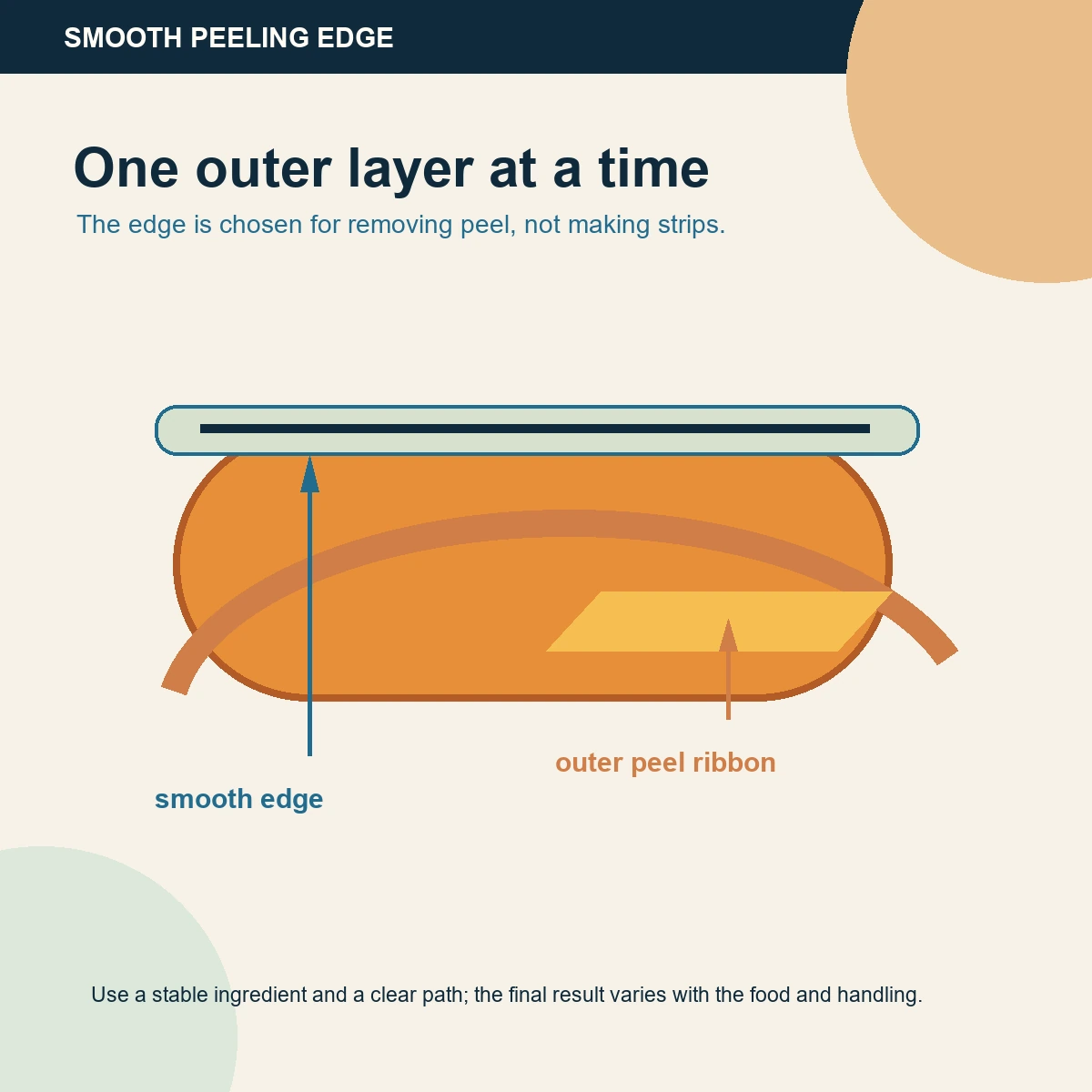
That distinction matters because a julienne edge is not simply a “sharper” version of a peeling edge. It has a different opening and a different contact pattern. Trying to use the toothed side for an everyday peel can give you a preparation you did not intend. Likewise, a smooth edge cannot create the narrow cut pattern of a julienne edge. The best choice starts with the shape you want on the cutting board.
When a smooth peeling blade is the right choice
Choose a smooth edge when the task is to remove the skin while keeping the underlying food in a relatively broad piece. Typical examples include peeling a potato before roasting, taking the skin from a carrot for a soup, or removing a cucumber peel for a salad. It is also the natural starting point for fruit where the peel is the part you do not plan to serve.
Work with a stable ingredient and a clear cutting path. Hold the food so your supporting hand stays away from the blade, and use strokes that match the curve rather than forcing the tool through an awkward angle. Produce varies in firmness, moisture and shape, so a good result depends on the ingredient and the way it is held. A product page can describe the edge, but it cannot guarantee an identical experience with every item in your kitchen.
If your shopping list is mostly conventional peeling, look for a complete smooth edge, a comfortable way to keep the tool oriented, and a handle that suits your preferred grip. Handle style is a separate decision from blade function, which is why an I-shape and a Y-shape can both be paired with a smooth peeling edge. Our guide to I-shape versus Y-shape vegetable peelers covers that grip question without changing what the blade is designed to do.
When a julienne blade is the better fit
A julienne edge is useful when you want narrow strips for a salad, a bowl, a garnish or a quick vegetable topping. Carrots, cucumbers and firm zucchini are common examples, although the ingredient still needs to be firm enough to hold its shape as you work. The edge creates the cut pattern. It does not promise that every strip will be the same width or that every ingredient will behave the same way.
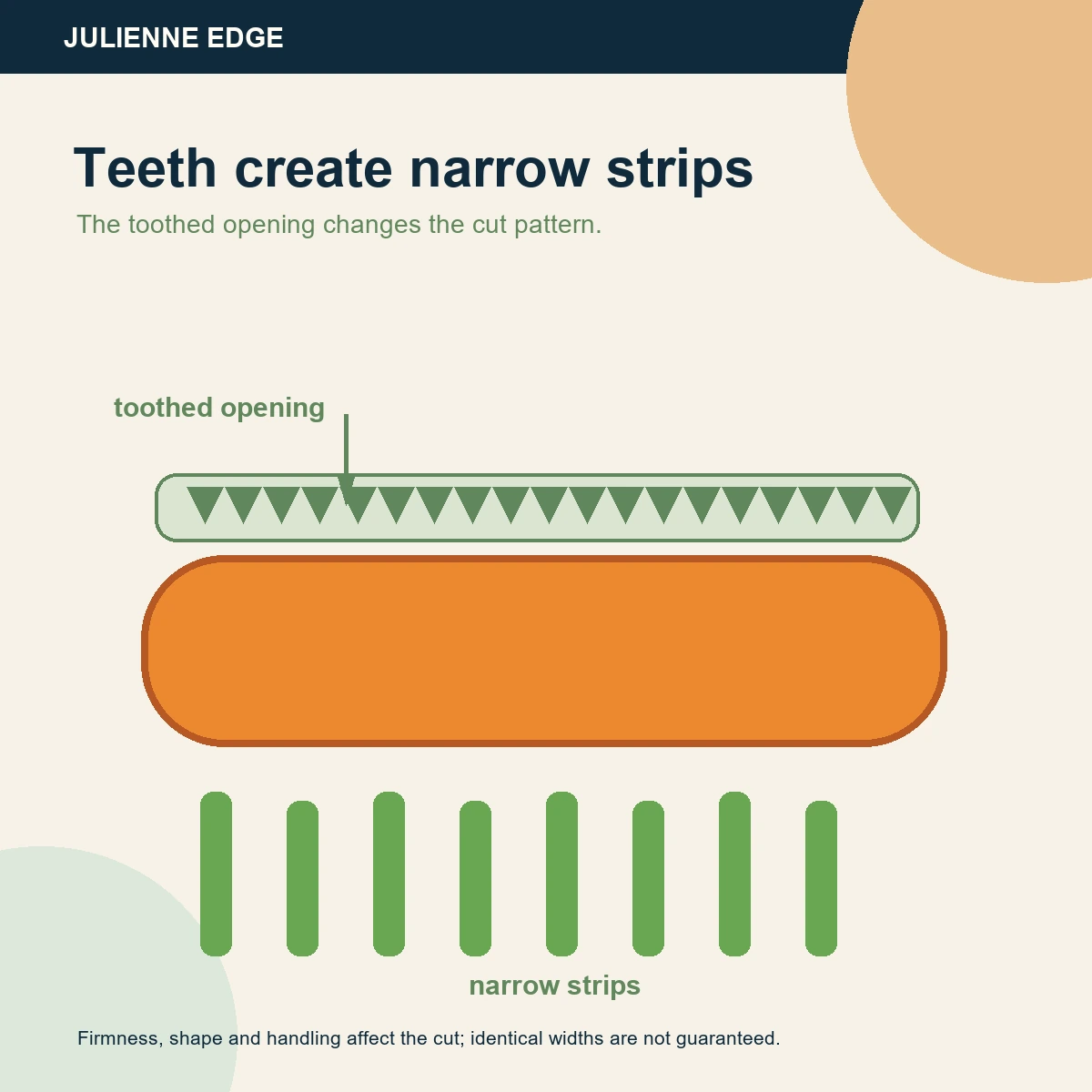
For a clean, controlled pass, place the ingredient on a stable surface or hold it securely with your non-cutting hand. Keep your fingers clear of the toothed opening and use a stroke that follows the length of the food. If the piece is short, soft or irregular, stop before your fingers approach the working edge and finish the remaining portion with another method. Kitchen tools should be used according to their supplied instructions and the condition of the food in front of you.
Our guide to julienne vegetables for salads and bowls shows how to plan the cut around the recipe. It treats the blade as a way to create strips, not as a promise of restaurant-style uniformity. That is the right expectation for any hand tool: choose the edge for the job, then let the ingredient and your technique determine the final shape.
Why blade function and handle shape are separate choices
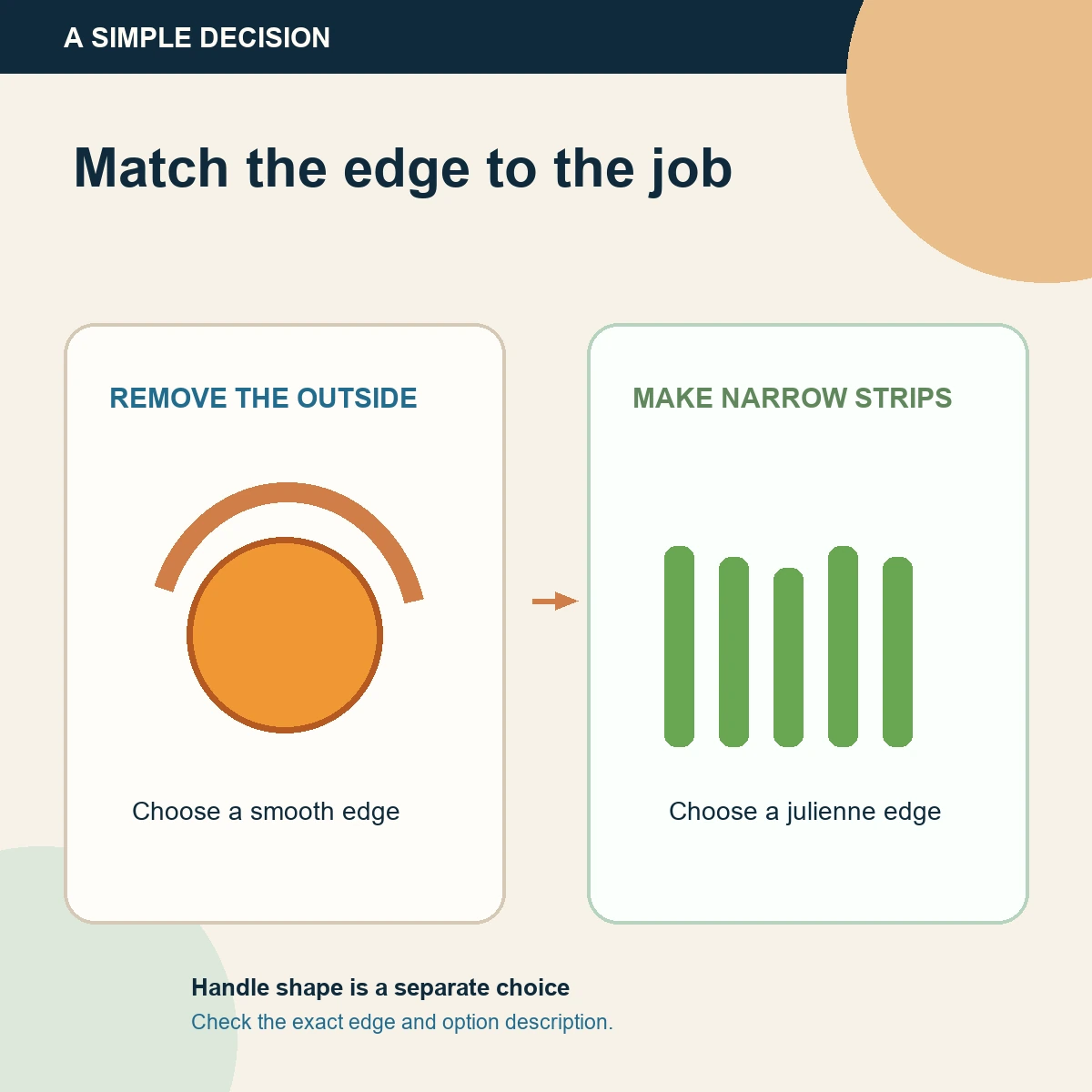
People often compare an I-shape peeler with a Y-shape peeler as if the handle alone determines what the tool can cut. It does not. Handle layout affects how the tool sits in your hand and how you approach the food. The cutting edge still determines whether the tool peels a surface or makes narrow strips.
This is why a buying comparison should answer two questions in order:
- Which edge matches the food preparation you actually do?
- Which handle layout feels easiest to control for that preparation?
Starting with the handle can lead you to choose a beautiful shape that does not include the function you need. Starting with the edge keeps the decision practical. If you already know you want both functions, then compare how the two-edge head is arranged and whether switching sides is clear in the supplied instructions.
Should you buy a two-edge peeler?
A two-edge peeler is worth considering when your routine regularly alternates between broad peels and narrow vegetable strips. ANGEER’s dual-blade julienne peeler describes one smooth peeling edge and one toothed julienne edge in the same head. That is a function description, not a claim that the tool is faster, easier for everyone or suitable for every ingredient.
The main convenience is having both edge types available without reaching for two separate handheld tools. The trade-off is that you need to identify the working side before you begin and keep the unused side away from your fingers and the food. Read the product instructions, use the side that matches your intended cut, and set the tool down safely when you change tasks.
If you want several handle layouts rather than two edges in one head, the stainless-steel 2-in-1 peeler collection lists I, Y and I + Y options. The page describes smooth and julienne functions for the listed stainless-steel options. Check the exact option name and the visible specification before adding it to your cart; an I-shape or Y-shape label alone does not tell you which edge is included.
A practical smooth-blade versus julienne-blade checklist
| Your intended preparation | Edge to look for | What to verify before buying |
|---|---|---|
| Remove the skin from potatoes, carrots, apples or cucumbers | Smooth peeling edge | The product description clearly identifies a peeling blade and the matching size or style. |
| Make narrow strips for salads, bowls or toppings | Toothed julienne edge | The description explicitly identifies a julienne blade; do not infer it from the handle shape. |
| Switch between peeling and strip-making in one prep session | Both edges in a two-edge head | Which side performs each function, how to hold it, and which exact variant you are selecting. |
| Choose between I-shape and Y-shape layouts | Decide the edge first, handle second | The handle description and the blade description both match the product option. |
Notice what is not on the checklist: a universal “best” label, a promised number of strokes, or a claim that one blade works for every fruit and vegetable. Those details are not reliable substitutes for matching the edge to the food. A clear product description and an honest use boundary are more helpful than a performance promise.
Use and care notes that apply to either edge
Before starting, check that the ingredient is stable, the blade is free of food residue and the cutting path is clear. Keep the working edge pointed away from your supporting fingers. When you finish, follow the supplied care instructions, dry the tool as directed and store it where the blade will not contact loose items in a drawer. If you are unsure which side is the smooth edge and which side is the julienne edge, pause and check the product labeling or instructions instead of guessing.
For a two-edge tool, make the side change deliberately. Put the tool down, reorient it, and confirm the new edge before resuming. That small pause keeps the intended function clear and avoids treating the two openings as interchangeable. If an ingredient is too soft, too small or awkward to hold, choose another preparation method and keep your hand away from the edge.
FAQs
Is a julienne blade the same as a peeling blade?
No. A smooth peeling blade removes an outer peel. A toothed julienne blade makes narrow strips. They are different edge functions, even when they appear on the same tool.
Can I use the smooth side to make julienne strips?
No. The smooth side is designed for peeling, so it does not have the toothed opening used to separate narrow strips. Use a clearly identified julienne edge for that preparation.
Does an I-shape peeler always have a julienne blade?
No. I-shape and Y-shape describe handle layouts, not a guaranteed blade function. Check the product description for the exact edge included with the selected option.
Are two-edge peelers useful for everyday cooking?
They can be useful if you regularly alternate between ordinary peeling and strip-making. The value is having both functions in one head. You still need to identify the correct side and follow the supplied handling instructions.
Will a julienne blade make identical strips from every vegetable?
No result can be assumed for every ingredient. Firmness, shape and the way the food is held affect the cut. A julienne edge is intended for narrow strips, but it does not guarantee identical widths or a particular finish.
How do I choose between one smooth edge and a two-edge tool?
List the preparations you make most often. If peeling is the only recurring task, a smooth edge may be enough. If you also make narrow strips, compare a two-edge option with the exact handle and care instructions that fit your routine.
Bottom line: choose the edge for the cut you want, then choose the handle for the way you work. A smooth blade is for peeling. A julienne blade is for narrow strips. Once those functions are clear, a product page becomes much easier to read and a two-edge tool becomes a practical option rather than a vague “more features” promise.