
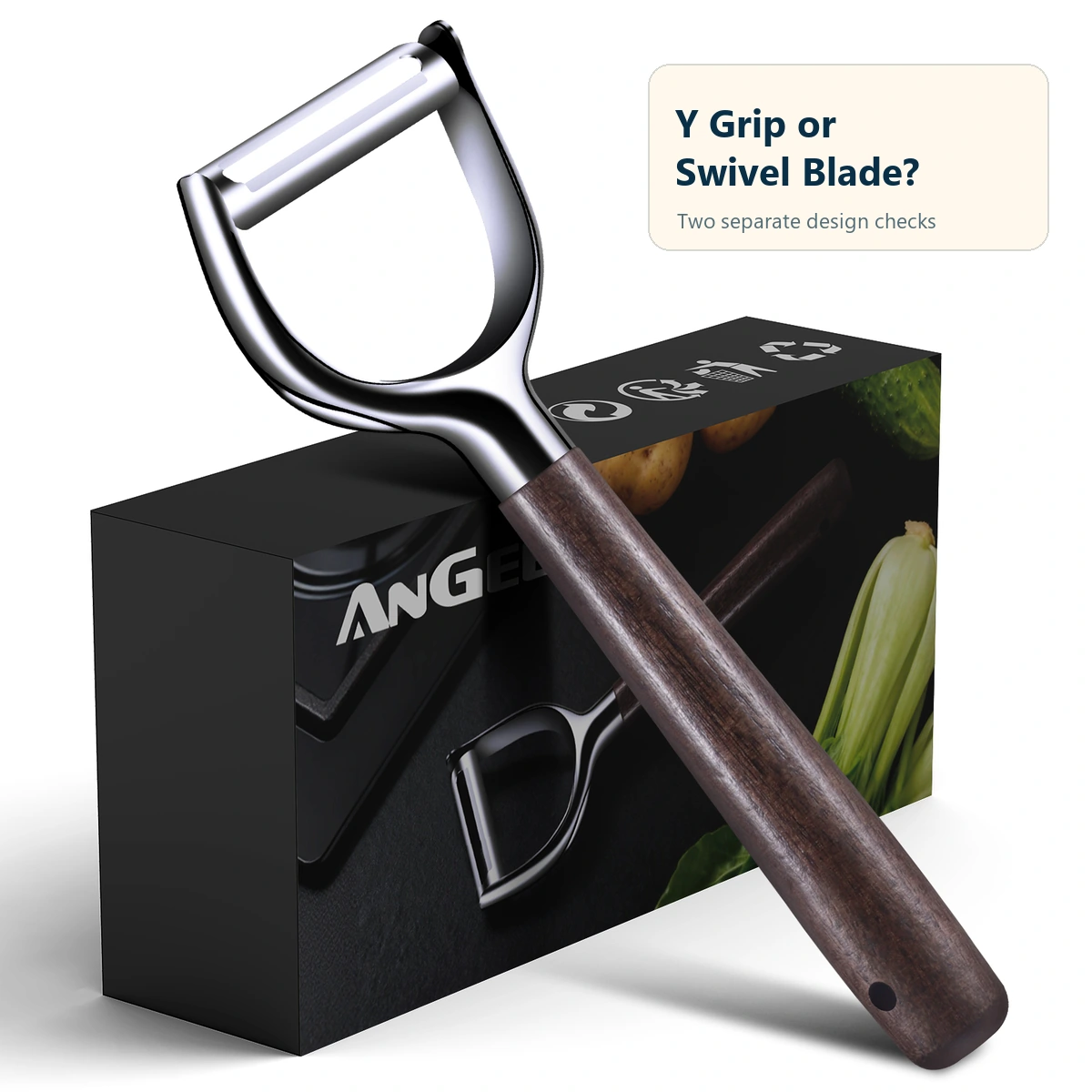
These labels sound like competing choices, but they describe different parts of a vegetable peeler. Knowing which part each word refers to makes product listings much easier to compare.
The short answer
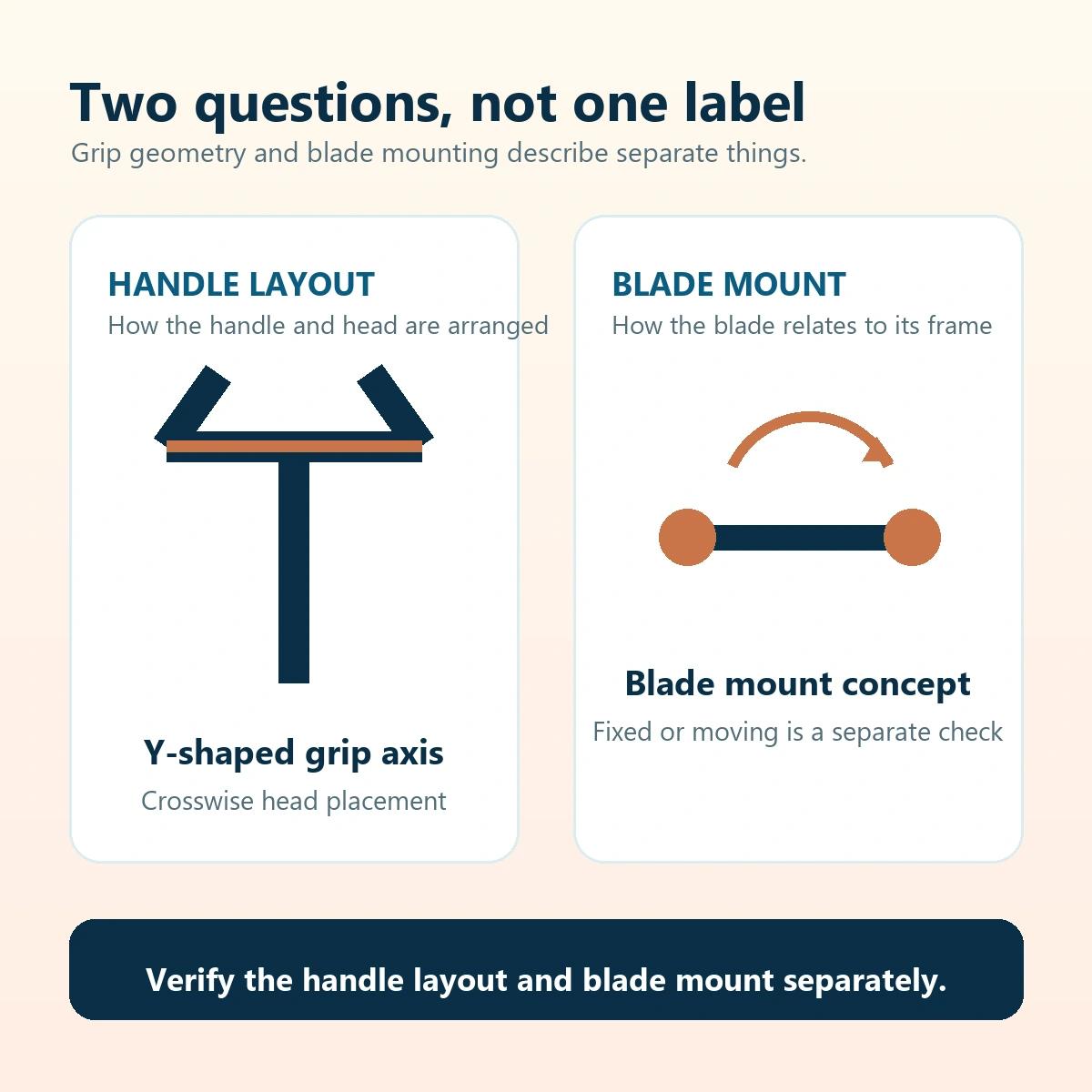
A Y-peeler is named for its handle and crosswise head layout. A swivel peeler is named for a blade that can move relative to its mount. One term describes how you hold the tool; the other describes how the blade is attached. A Y-shaped peeler may have a fixed blade or a moving blade, so the phrase “Y-peeler vs swivel peeler” is not a clean either-or comparison.
If you are shopping, check two things separately: whether the Y-shaped grip suits the motion you can guide steadily, and whether the exact model’s blade is documented as fixed or moving. Do not assume a blade swivels just because the frame is Y-shaped.
Two labels, two parts of the tool
Retail names often compress several design details into one short title. That is convenient for a product grid, but it can hide the distinction a buyer needs. Handle layout, blade function, and blade mounting are separate questions.
| Question | Y-peeler | Swivel peeler |
|---|---|---|
| What does the term describe? | The handle and head form a Y-shaped layout, with the cutting edge running across the top. | The blade can move relative to its mount instead of remaining completely fixed. |
| What can you verify in a still photo? | The frame shape, grip orientation, head width, and visible blade type. | Usually very little. A still image may show the mounting points, but it may not prove that the blade moves. |
| What should a useful video show? | How the person holds the handle and guides the head over the ingredient. | A close view of the blade moving against the frame, ideally before and during a stroke. |
| What does the label not prove? | That the tool is faster, safer, more comfortable, or suitable for every hand. | A particular travel range, thinner peel, better contour contact, or resistance to clogging. |
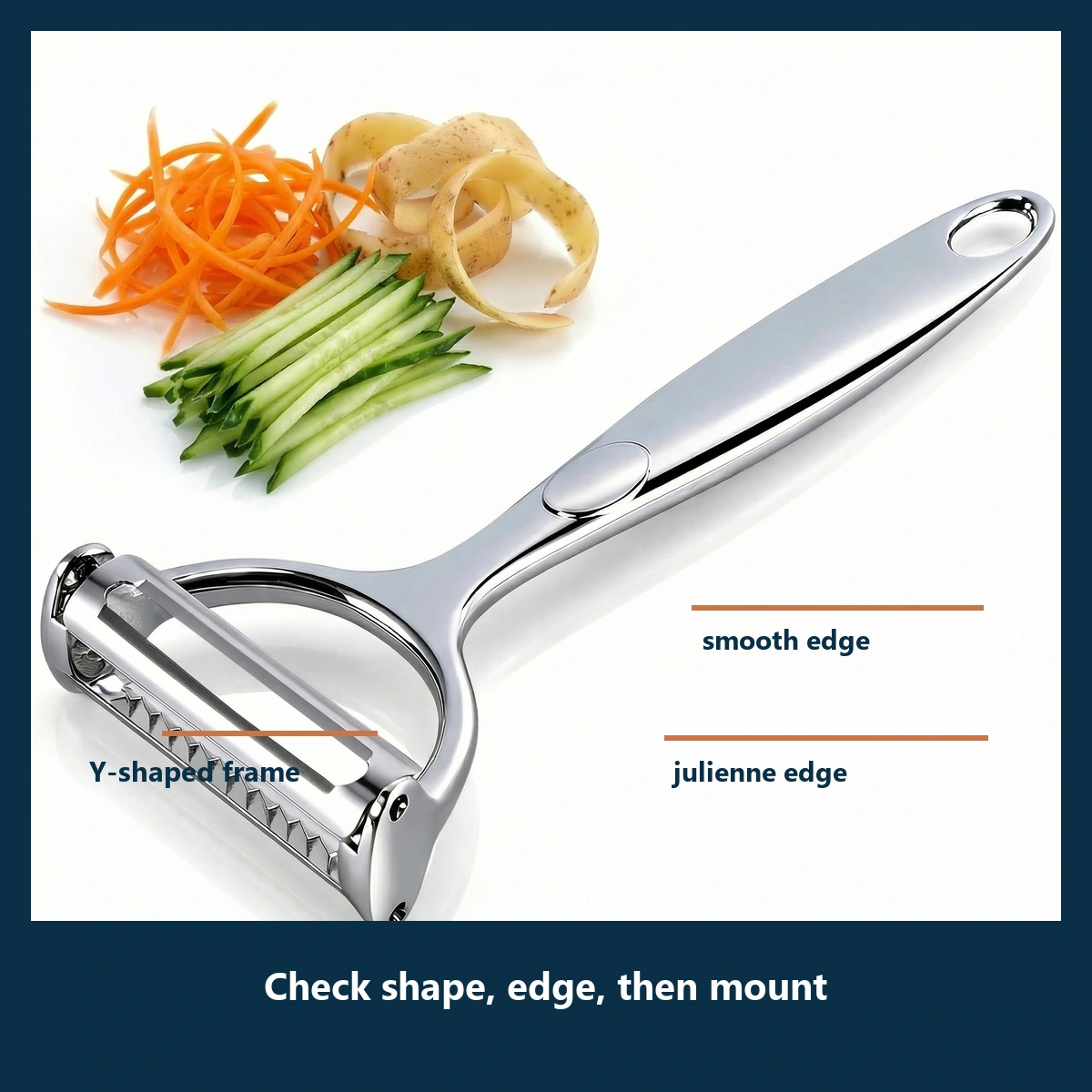
The same separation applies to smooth and julienne edges. Those words describe what the blade is intended to do, not the shape of the handle. If you want the full grip-layout comparison, the existing I-shape versus Y-shape vegetable peeler guide covers that choice without mixing it with blade movement.
What the Y-shaped grip changes
On a Y-peeler, the blade sits across the top of the frame. The handle points away from the head, and your hand approaches the ingredient behind that crosswise cutting edge. In current ANGEER demonstration footage, users hold the wood handle in the palm and guide the head across potatoes, apples, carrots, and longer vegetables. The footage establishes the grip and the visible prep motion. It does not establish which hand position is universally easier.
Food shape changes the contact you can see. A round apple presents a changing curve during the stroke. A long carrot offers a narrower path. A potato combines curves, shallow dents, and changes in width. Those differences can affect how often a cook pauses, turns the ingredient, or resets the tool. They do not make one handle shape the automatic winner.

Before buying, mimic the motion with an unsharpened kitchen utensil of similar width. Notice whether you prefer guiding a crosswise head or a narrower in-line tool. This is only a grip check, not a safety or performance test. The broader vegetable peeler buying guide adds blade purpose, produce fit, handle material, and care to that decision.
What a swivel blade changes, and what it does not prove
A swivel blade is mounted so it can move relative to the surrounding head. That mechanical detail is different from the orientation of the handle. A manufacturer can put a moving blade in a Y-shaped frame or in an I-shaped frame. It is also possible for a Y-shaped frame to hold a blade that does not visibly pivot.
The word “swivel” alone tells you neither the amount of movement nor the result on food. Listings rarely state a measured angle, and a product photo with arrows is not the same as a close demonstration. If the motion matters to your purchase, look for footage of the exact model in which the blade and its mounting points remain visible while the blade is pressed lightly and released.
ANGEER’s current source set illustrates why this check matters. A supplier image for one wood-handle Y model labels the blade design as adaptive and swiveling. The matching use footage clearly shows the Y-shaped grip and peeling strokes, but it does not isolate blade travel well enough to support a degree value or a performance promise. This article therefore treats the image as a product label, not proof that the tool follows every curve, prevents clogging, works faster, or needs less effort.
A five-step check before you buy
- Identify the handle layout. Look for a clear front view. A Y-shaped frame has a crosswise head supported at both sides.
- Identify the blade function. A smooth peeling edge and a toothed julienne edge do different jobs. Do not confuse that choice with the blade mount.
- Verify the moving part. If the listing says swivel, look for a close video that shows the blade moving against the frame. Do not infer motion from arrows or the frame shape.
- Match every claim to the exact variant. A set may include I and Y tools, while a single-style option includes only one. Images from another color, handle material, or pack are not proof for the selected item.
- Ignore universal-winner language. A label does not prove speed, safety, comfort, reduced fatigue, or suitability for a health condition. Choose from visible geometry, verified functions, and the motion you can control.
The stainless-steel I and Y peeler range and the wood-handle I and Y peeler range both use exact variant selectors. Check the selected style and included pieces before relying on a gallery image or comparison graphic.
Let food shape refine the decision
Round and irregular produce gives the tool a changing surface. Long vegetables offer a more continuous path but still vary in firmness and width. A useful product demonstration should show both the starting contact and the rest of the stroke, not only a finished pile of peel.
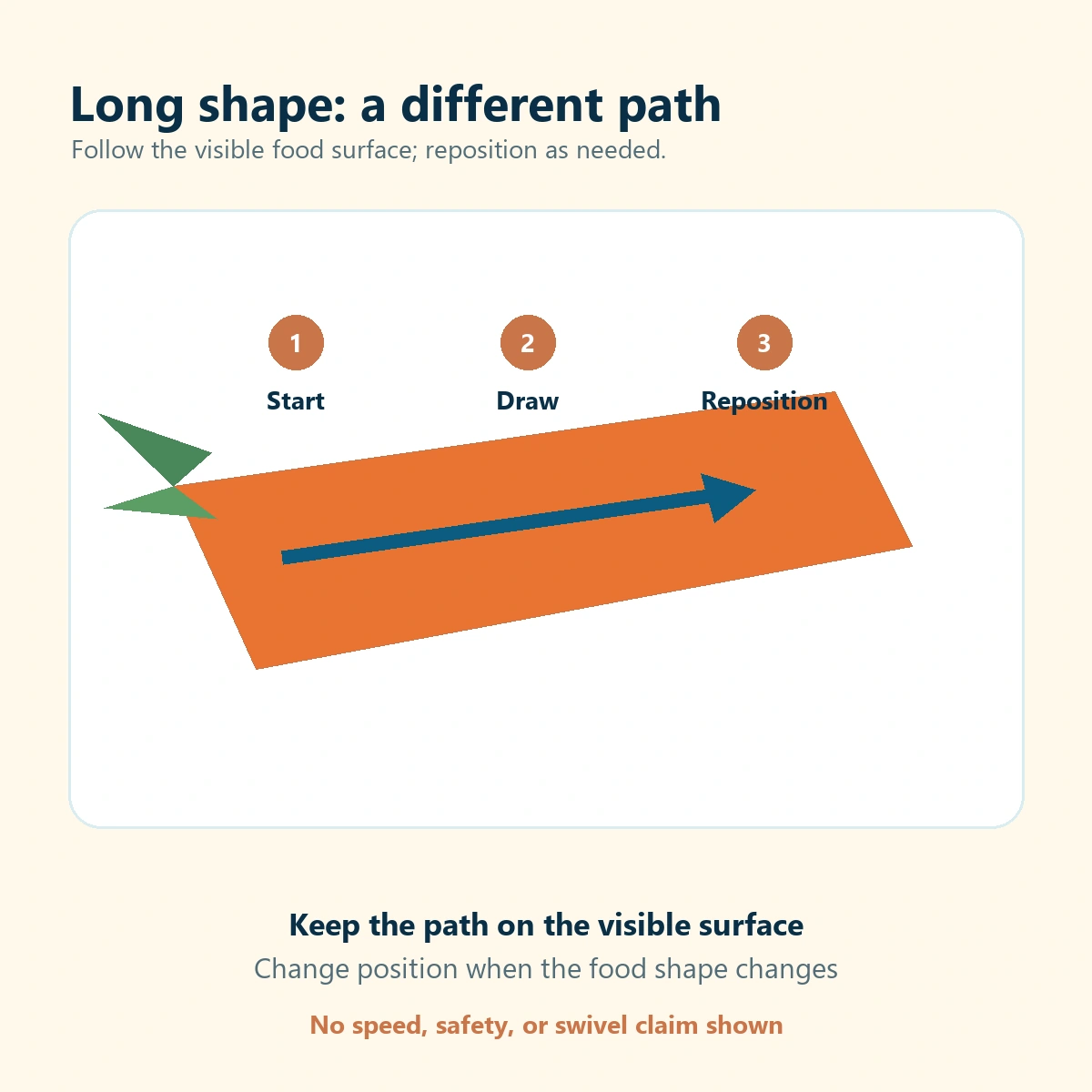
For a round ingredient, watch how often the user turns the food and resets the head. For a carrot or cucumber, watch whether the ingredient is supported on a board or held securely, and whether the path stays clear of the supporting hand. These observations tell you more about the demonstrated workflow than a claim such as “perfect for every vegetable.” They still do not guarantee your result, because ingredient firmness, surface moisture, blade condition, and technique vary.
Once the tool arrives, begin with a clean, firm ingredient and a short controlled stroke. Keep your fingertips outside the blade path, stop if the tool or food shifts, and reset your grip instead of forcing the cut. The goal is to learn how the exact tool behaves in your hand, not to reproduce the speed of an edited product clip.
The buying decision in one minute
Choose the Y-shaped layout only after you have checked the crosswise grip. Treat swivel as a second, separate specification, and ask what evidence proves it for that exact model. If the listing shows only a still image, the honest conclusion is that the motion remains unverified.
That small distinction prevents a common buying mistake. You are not choosing between a Y-peeler and a swivel peeler as if only one label can apply. You are choosing a handle layout, a blade function, and a blade mount. Verify all three, then match the demonstrated motion to the produce you prepare most often.
Y-peeler and swivel peeler FAQ
Is a Y-peeler the same as a swivel peeler?
No. A Y-peeler is named for its frame and grip layout. A swivel peeler is named for a blade that can move relative to its mount. One tool can have both features.
Can a Y-peeler have a fixed blade?
Yes. The Y-shaped frame does not prove that the blade moves. Check the exact model specification or a close demonstration before calling it a swivel peeler.
Does a swivel blade make a peeler safer or faster?
Not by itself. The label does not prove speed, safety, comfort, peel thickness, or reduced effort. Those outcomes require model-specific evidence and still depend on the ingredient and technique.
How can I tell whether a blade really swivels?
Look for a close video of the exact model that keeps the blade and mounting points visible while the blade is pressed and released. A still image, arrow, or Y-shaped frame is not enough to show actual travel.
Which food shapes should I check in a demonstration?
Look for both round produce, such as an apple or potato, and long produce, such as a carrot or cucumber. Watch the starting contact, stroke path, and resets rather than judging only the finished peel.
What does ANGEER’s current Y-peeler footage prove?
It proves the visible Y-shaped grip and shows peeling strokes on several kinds of produce. It does not clearly prove a measured swivel range, no-clogging performance, greater speed, or reduced hand fatigue.
Sources
- ANGEER supplier-provided wood-handle Y-peeler specifications, product images, and six demonstration videos, reviewed August 31, 2026.
- ANGEER, “I-Shape vs Y-Shape Vegetable Peeler: Which Grip Fits Your Prep?”, production page reviewed August 31, 2026.
- ANGEER, “How to Choose a Vegetable Peeler: Grip, Blade & Care”, production page reviewed August 31, 2026.